

-
Asia Pacific Artificial Flowers Market to Record the Fastest Growth
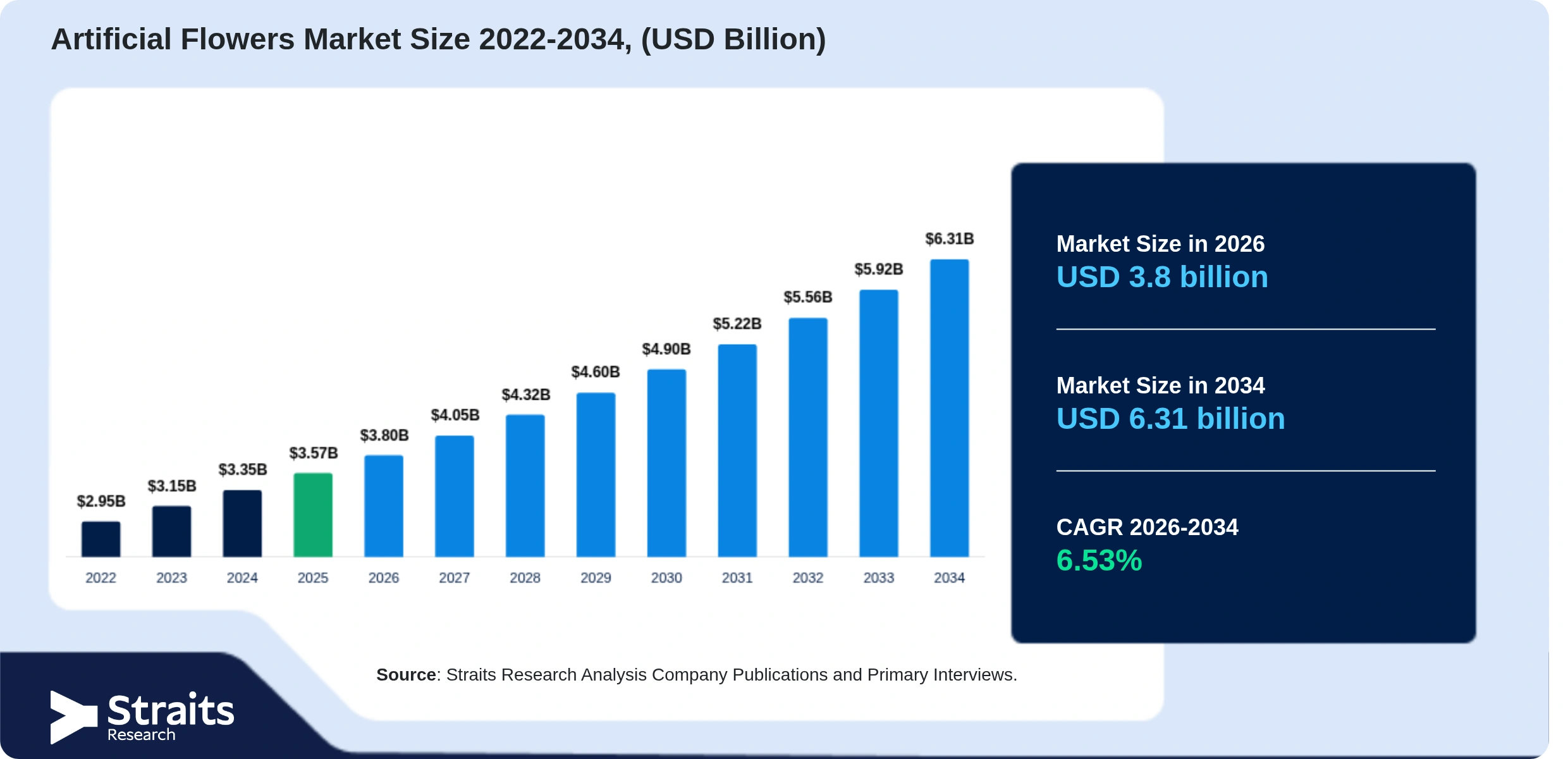
The global artificial flowers market was valued at USD 3.57 billion in 2025 and is projected to increase from USD 3.80 billion in 2026 to USD 6.31 billion by 2034, registering a CAGR of 6.53% during the forecast period (2026–2034). Demand for low-maintenance floral decorations, customized arrangements, and reusable event décor supports the industry’s outlook. North America held the largest regional share in 2025, while Asia Pacific is projected to record the fastest regional expansion, with a CAGR of 7.2% during the forecast period.
Artificial Flowers Market Key Takeaways
Market Size (2025): USD 3.57 billion
Market Size (2026): USD 3.80 billion
CAGR (Forecast Period): 6.53% (2026–2034)
Forecast Year: 2034
Projected Market Size (Forecast Year): USD 6.31 billion
Dominant Region: North America, with a 34% share in 2025
Fastest Growing Region: Asia Pacific, with a CAGR of 7.2% (2026–2034)Artificial Flowers Market Overview
Artificial flowers are synthetic replicas of natural blooms manufactured from materials such as silk, plastic, latex, and polyester. Improvements in materials and production techniques allow manufacturers to create decorative flowers with realistic colors, textures, and shapes. These products serve residential interiors, hotels, offices, weddings, retail displays, and other commercial settings where durable decorations are preferred.The industry includes manufacturers, wholesalers, home décor retailers, online sellers, and specialized floral designers. Product appearance, material durability, design variety, and distribution reach influence competition across these channels.
Artificial Flowers Market Growth Drivers
Commercial interior design and e-commerce distribution support demand for artificial floral products. Hotels, restaurants, offices, and event venues use these arrangements to maintain consistent décor without the watering and frequent replacement associated with fresh flowers. Online retail channels also help manufacturers and sellers reach households, event planners, and commercial customers through wider product selection, customer reviews, and home delivery.Artificial Flowers Market Challenges
Seasonal purchasing patterns can create uneven sales throughout the year, particularly around weddings, festivals, holidays, and other celebrations. Manufacturers and retailers must manage inventory carefully to reduce storage costs and discounting during quieter periods.Environmental concerns present another challenge because many artificial flowers contain synthetic materials that can be difficult to recycle. Manufacturers may face pressure to develop more sustainable materials and production methods while maintaining realistic appearance, durability, and competitive pricing.
Artificial Flowers Market Opportunities
Customized floral arrangements offer opportunities for premium products designed for homes, hospitality venues, memorial settings, and branded commercial spaces. Partnerships with interior designers and specialty décor retailers can help suppliers reach customers seeking distinctive arrangements.Reusable floral rentals also create recurring revenue opportunities for event decorators and rental companies. Wedding planners, corporate event organizers, and exhibition operators can use rented arrangements across multiple occasions, potentially reducing the need to purchase new decorations for every event.
Artificial Flowers Market Segment Analysis
By type, bouquets dominated with a 29% share in 2025, supported by their use in home decoration, gifting, and celebrations. The trees segment is expected to register a CAGR of 6.1% during the forecast period as consumers and commercial buyers seek realistic indoor greenery.By material, silk held a 31% share in 2025 due to its realistic appearance and soft texture. Polyester is expected to register a CAGR of 6.4% during the forecast period, reflecting its durability and flexibility across colors and designs.
By application, residential use accounted for a 38% share in 2025, supported by demand for decorations that retain their appearance with minimal maintenance. Events and weddings are expected to register a CAGR of 6.7% during the forecast period as reusable arrangements and customized designs gain relevance.
By distribution channel, online sales are expected to register a CAGR of 7.4% during the forecast period, supported by convenient shopping and broader product selection. Offline retail stores and wholesale channels are projected to register a CAGR of 4.8% during the forecast period, reflecting customers’ preference to examine colors, textures, and finishes in person.
Artificial Flowers Market Regional Analysis
North America held the largest regional share at 34% in 2025. The U.S. imported approximately USD 1.07 billion worth of artificial flowers and related products in 2025, supporting product availability through retail and decoration channels.Asia Pacific is projected to register a CAGR of 7.2% during the forecast period, making it the fastest-growing regional market. China exported approximately USD 2.84 billion worth of artificial flowers under HS code 670210 in 2025, highlighting its substantial role in international manufacturing and distribution. India and Japan also participated in artificial flower exports during the year.
Europe is projected to register a CAGR of 5.1% during the forecast period. Germany exported approximately USD 66.45 million worth of artificial flowers under HS code 670210 in 2025, demonstrating its participation in international trade.
Artificial Flowers Market Competitive Landscape
The artificial flowers market is highly fragmented, with manufacturers, wholesalers, home décor brands, retailers, and specialist craft producers competing across price points and product categories. Nearly Natural, Afloral, and FloraCraft are among the established participants, alongside Tree Classics and International Silks Artificial Flowers.Established players compete through product realism, material quality, design variety, distribution networks, and relationships with commercial buyers. Emerging and regional players in the artificial flowers market ecosystem compete through customized arrangements, distinctive designs, affordable products, online sales, and alternative materials.
Key Companies in the Artificial Flowers Market
The Green Vase
Real Touch Artificial Flowers
YUWA Co., Ltd.
Silks Unlimited
International Silk Flowers
Afloral
Kriya Creations
Wisteria
Nearly Natural, Inc.
Darice, Inc.
Design Master
Tree Classics
FloraCraft
Jamali GardenRecent Developments in the Artificial Flowers Market
May 2025: Nearly Natural expanded its artificial flower portfolio with realistic floral arrangements and seasonal décor collections for residential and commercial settings.
June 2025: IKEA expanded its artificial plant and flower décor range with collections focused on affordable, low-maintenance home decoration.
July 2025: Kaemingk expanded its artificial floral and seasonal decoration portfolio for retail, hospitality, and home décor applications.
September 2025: Sullivans expanded its artificial flower portfolio with realistic floral designs targeting home décor retailers and interior styling applications.Artificial Flowers Market Future Outlook
The artificial flowers market is positioned for continued expansion through 2034 as residential decoration, commercial interiors, online shopping, and reusable event arrangements support demand. Custom designs and rental services may create additional revenue opportunities for manufacturers, floral designers, and event businesses. Companies that balance realistic appearance, durability, design variety, and material sustainability may be better positioned to serve changing customer preferences.Click Here to Access the Comprehensive Report: https://straitsresearch.com/report/artificial-flowers-market
About Straits Research
Straits Research is a global market intelligence and consulting company that provides industry analysis, market insights, and strategic research to help businesses understand market dynamics, evaluate competitive environments, and identify commercial opportunities. Its research supports informed decision-making across industries and markets.
Media
Sorry, no items found.