

-
Silica Market to Reach USD 138.90 Billion by 2034 at 9.4% CAGR
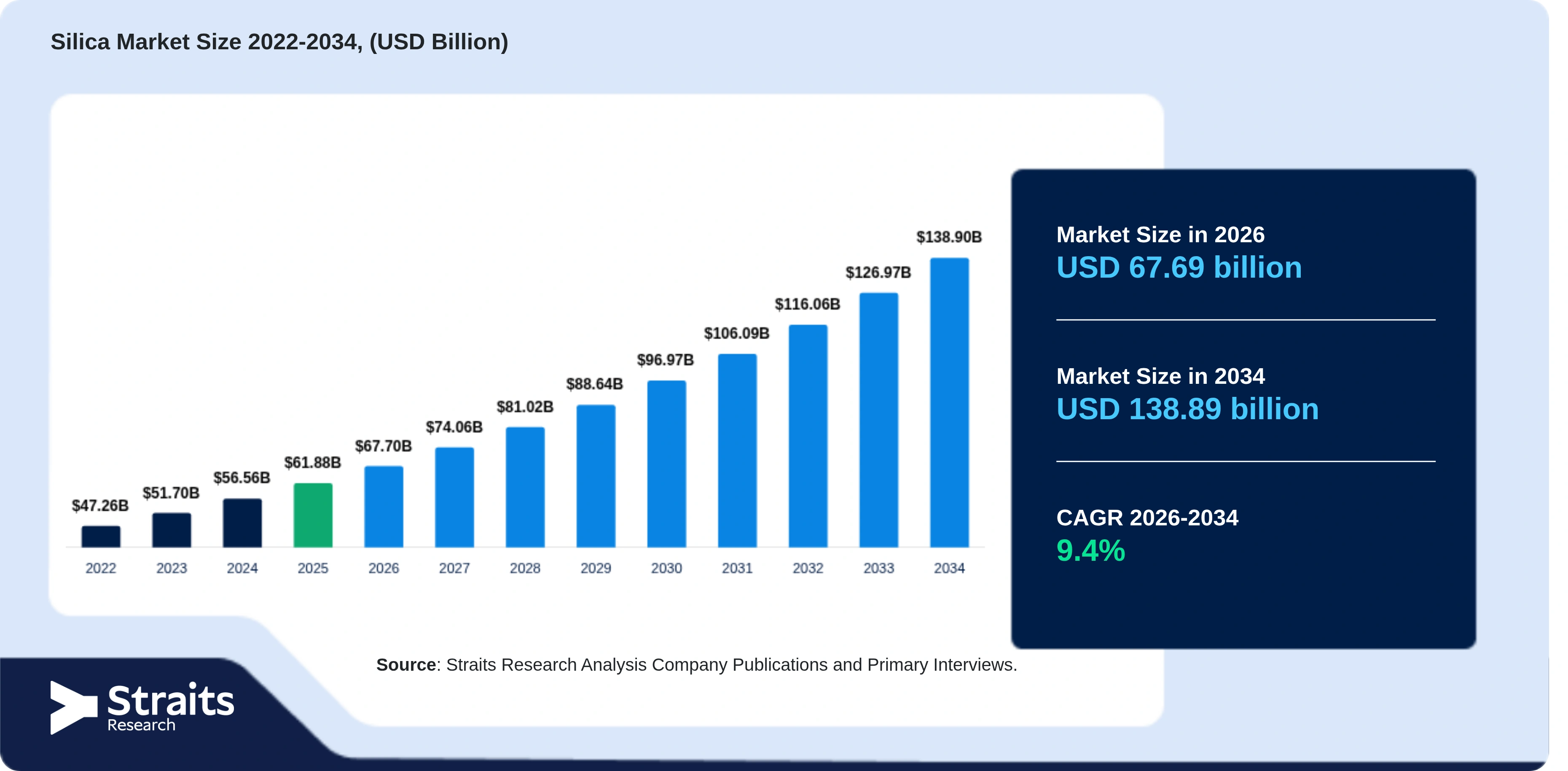
The global silica market was valued at USD 61.88 billion in 2025 and is projected to grow from USD 67.70 billion in 2026 to USD 138.90 billion by 2034, registering a CAGR of 9.4% during the forecast period (2026–2034). Asia Pacific dominated the market in 2025, accounting for 43.6% of global revenue, while North America is expected to be the fastest-growing regional market.
Market Size (2025): USD 61.88 billion
Market Size (2026): USD 67.70 billion
CAGR (Forecast Period): 9.4% from 2026 to 2034
Forecast Year: 2034
Projected Market Size (2034): USD 138.90 billion
Dominant Region: Asia Pacific—43.6% market share in 2025
Fastest Growing Region: North America
Market Overview
Silica, or silicon dioxide, is a naturally occurring compound used in construction materials, glass manufacturing, industrial processing, rubber products, and specialty chemical applications. It is available in crystalline and amorphous forms, each offering distinct physical and chemical properties for different end uses. Construction materials, glass production, and tire manufacturing are important application areas, while specialty silica grades support uses in coatings, adhesives, personal care products, and other industrial formulations.Growth Drivers
Infrastructure development and construction activity support silica consumption through its use in concrete, mortar, cement-related products, and other building materials. Glass manufacturers also rely on silica as a primary raw material for architectural glazing, containers, and industrial glass products. In automotive manufacturing, precipitated silica is used in tire compounds to improve rolling resistance and wet grip, creating an additional growth avenue as tire producers develop more energy-efficient products.Market Challenges
Silica producers face operational challenges associated with energy consumption, raw-material quality, processing costs, and transportation, particularly for bulk industrial grades. Crystalline silica dust also presents serious occupational health risks when inhaled, requiring effective exposure controls, dust suppression, ventilation, and protective measures in mining and processing facilities. Compliance with workplace safety requirements can increase operating costs and influence equipment and facility design.Market Opportunities
Specialty chemical manufacturers can develop high-purity and performance-specific silica grades for applications in electronics, coatings, adhesives, personal care, and advanced industrial materials. Sustainable production methods, including the use of agricultural residues such as rice husk, offer opportunities to diversify feedstocks and develop lower-impact silica products. Suppliers can also collaborate with tire manufacturers to produce highly dispersible silica grades that support improved tire performance and evolving sustainability requirements.Segment Analysis
By type, the amorphous silica segment is a major contributor to the silica market and is estimated to register a CAGR of 6.60% during the forecast period. Its versatility, adjustable surface properties, and suitability for applications ranging from rubber reinforcement to coatings and specialty formulations support its commercial relevance.By end-user industry, the building and construction segment is a major contributor to the market and is estimated to grow at a CAGR of 6.90% during the forecast period. Silica remains an important material in concrete, mortar, glass, and other construction-related applications, linking its consumption to infrastructure investment and building activity.
Regional Analysis
The Asia Pacific Silica Market accounted for the largest regional share of 43.6% in 2025. The region benefits from extensive construction activity, large glass-manufacturing operations, industrial production, and a substantial automotive and tire manufacturing base. China, India, Japan, and other regional economies provide important markets for both industrial silica and higher-value specialty grades.The North America Silica Market is expected to be the fastest-growing regional market during the forecast period. Construction materials, glass production, oil and gas applications, and specialty industrial uses contribute to regional opportunities. Europe also represents an established market, supported by industrial manufacturing and automotive applications, while Latin America and the Middle East and Africa offer opportunities linked to infrastructure development, industrial investment, and mineral processing.
Competitive Landscape
The Silica Market includes industrial mineral producers and specialty chemical manufacturers competing on product purity, particle characteristics, production capacity, technical support, pricing, and supply reliability. Established companies benefit from broad product portfolios, established customer relationships, and global manufacturing networks. Other suppliers can differentiate themselves through specialty grades, sustainable feedstocks, and products designed for specific applications in construction, automotive, and advanced materials.Key companies include:
AGSCO Corporation
AMS Applied Material Solutions
Cabot Corporation
Covia Holdings LLC
Sibelco
Recent Developments
In September 2026, Evonik announced plans to consolidate precipitated silica production in Germany by transferring output from its Rheinfelden and Düren facilities to a new large-scale plant in Marl. The facility is scheduled to begin operations at the end of 2028, while the older plants are planned to close by the end of 2029. The move is intended to improve operational efficiency, reduce environmental impact, and strengthen the company’s competitiveness.In April 2026, Cabot Sanmar announced a USD 25 million investment to expand fumed silica manufacturing capacity at its Mettur facility in Tamil Nadu, India. The brownfield expansion is intended to increase supply for applications including pharmaceuticals, paints and coatings, personal care, and specialty chemicals, with commissioning expected in the fourth quarter of 2027.
In May 2026, BASF signed an agreement to sell its silicates business, including assets at its Düsseldorf/Holthausen site, to PQ Corporation. The proposed transaction was expected to strengthen PQ’s global silicate platform, with completion subject to customary closing conditions and regulatory approvals.
Click to Read the Complete Insights & Report: https://straitsresearch.com/report/silica-market
Future Outlook
The silica market is projected to expand through 2034 as construction, glass manufacturing, automotive production, and specialty industrial applications continue to create opportunities across silica grades. Asia Pacific is expected to retain its leading position, while North America offers additional growth potential across established industrial applications. Future competitiveness will depend on efficient production, reliable feedstock access, compliance with occupational safety requirements, and the development of specialty and lower-impact silica solutions.About Straits Research
Straits Research is a market research and intelligence firm providing industry analysis, market sizing, forecasts, and strategic insights across multiple sectors. Its research supports businesses and decision-makers in understanding market dynamics, competitive positioning, and potential growth opportunities.
Media
Sorry, no items found.