

-
Aluminum Die Casting Market Trends Shaping Advanced Manufacturing
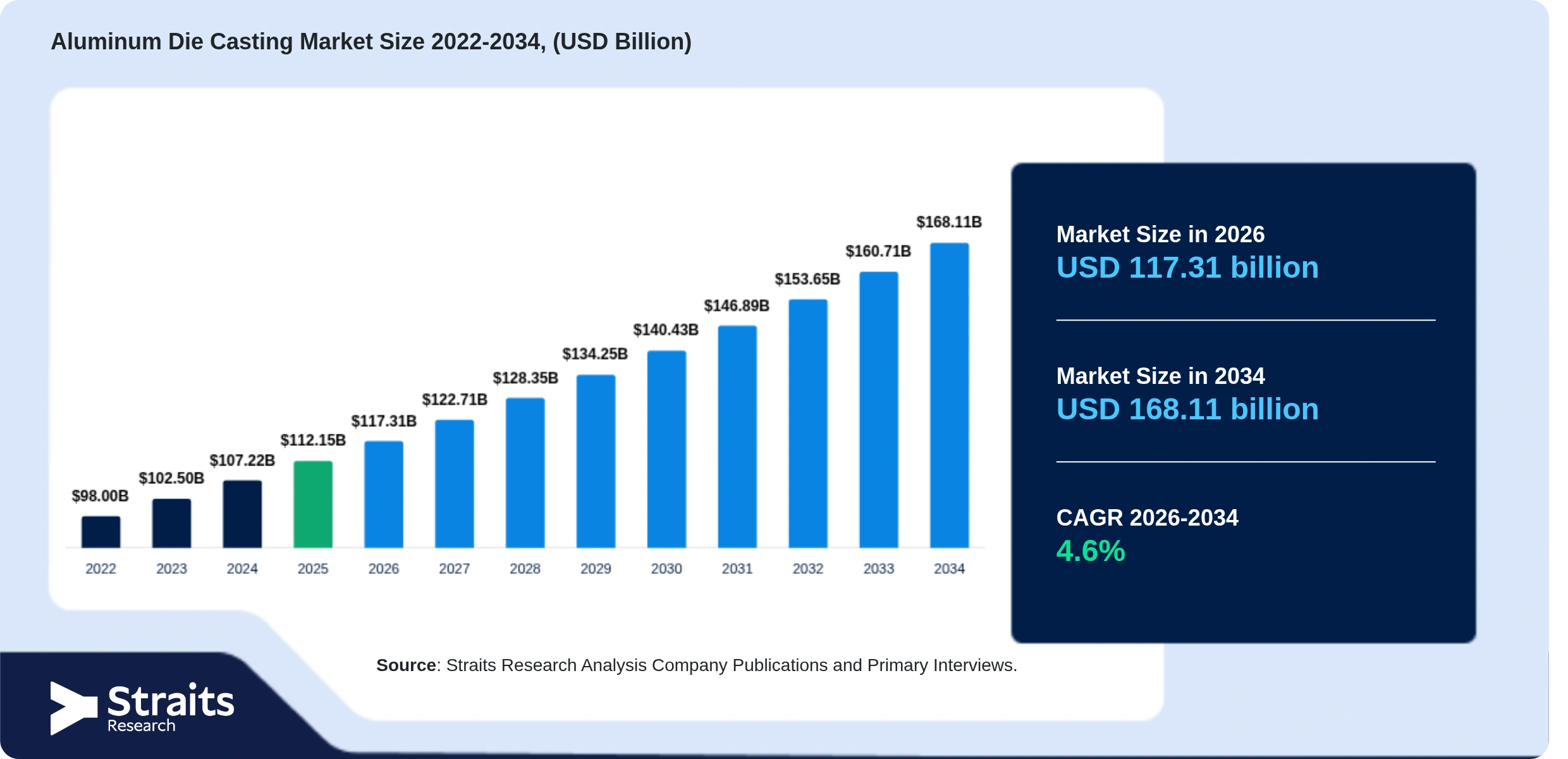
The global aluminum die casting market was valued at USD 112.15 billion in 2025 and is projected to grow from USD 117.31 billion in 2026 to USD 168.11 billion by 2034, registering a CAGR of 4.6% during the forecast period (2026–2034). Asia Pacific dominated the market in 2025, accounting for 42.6% of global revenue, while Europe is expected to be the fastest-growing region, with a projected CAGR of 7.48%.
Market Size (2025): USD 112.15 billion
Market Size (2026): USD 117.31 billion
CAGR (Forecast Period): 4.6% from 2026 to 2034
Forecast Year: 2034
Projected Market Size (2034): USD 168.11 billion
Dominant Region: Asia Pacific—42.6% market share in 2025
Fastest Growing Region: Europe – CAGR of 7.48% during 2026–2034
Market Overview
Aluminum die casting is a manufacturing process in which molten aluminum is injected into a reusable metal mold to produce components with precise dimensions and complex shapes. The process supports high-volume production of lightweight, durable parts for automotive systems, electric vehicles, industrial machinery, telecommunications equipment, and consumer products. High-pressure die casting is widely used for intricate components requiring consistent quality and short production cycles, while advances in mold design, automation, and process monitoring help manufacturers improve production efficiency and reduce material waste.Growth Drivers
Vehicle lightweighting supports the use of aluminum die-cast components in structural parts, housings, and powertrain systems because lower component weight can help improve vehicle efficiency. Electric vehicle production also creates opportunities for large aluminum enclosures, battery housings, and integrated structural parts. In parallel, automotive manufacturers and component suppliers use high-pressure die casting to consolidate multiple parts into fewer components, potentially reducing assembly steps and improving production efficiency.Market Challenges
High initial investment in die-casting machines, molds, and automated production lines can limit entry and expansion for smaller manufacturers. Tooling changes and the development of large, complex components also require engineering expertise and careful process control. In addition, defects such as porosity, shrinkage, and incomplete filling can increase scrap rates and rework costs, particularly when manufacturers must meet demanding structural and safety specifications.Market Opportunities
Die-casting companies can expand revenue through large structural castings, electric vehicle battery enclosures, motor housings, and lightweight components for commercial transportation. Investments in vacuum-assisted casting, advanced alloy development, and real-time quality monitoring can help suppliers meet stricter component requirements and reduce defect rates. Recycled aluminum also offers an opportunity to lower the material footprint of cast components, while manufacturers can differentiate themselves through closed-loop scrap recovery, energy-efficient furnaces, and production services tailored to automotive and industrial customers.Segment Analysis
By process, the high-pressure die casting segment dominated the market, accounting for 51.8% of the market share in 2025. Its ability to produce complex, dimensionally accurate components at high volumes supports its use across automotive, transportation, electronics, and industrial applications. Shorter production cycles and consistent part quality also make it suitable for large-scale manufacturing.By application, the automotive components segment is projected to register the fastest growth, at a CAGR of 7.41% during 2026–2034. Electric vehicle production and vehicle lightweighting support the use of aluminum die-cast battery housings, motor housings, structural parts, and powertrain components. Component consolidation through large castings also creates opportunities to reduce assembly complexity.
Regional Analysis
The Asia Pacific Aluminum Die Casting Market accounted for the largest regional share of 42.6% in 2025. The region benefits from extensive automotive manufacturing, electric vehicle production, and strong electronics and industrial machinery sectors. China remains a major market, while India’s expanding vehicle manufacturing base and Japan’s precision engineering capabilities support regional demand.The Europe Aluminum Die Casting Market is expected to grow at a CAGR of 7.48% during the forecast period, showcasing the fastest-growing regional market. Vehicle lightweighting, electric vehicle manufacturing, and demand for complex structural castings support regional expansion. Germany is a key market due to its automotive and engineering industries. North America also offers opportunities through automotive electrification and investment in advanced manufacturing, while Latin America and the Middle East and Africa benefit from industrial development and growing demand for lightweight components.
Competitive Landscape
The aluminum die casting market features established automotive component suppliers, specialist casting companies, and integrated manufacturers. Competition centers on casting precision, production capacity, tooling expertise, automation, quality control, and relationships with original equipment manufacturers. Companies are increasingly developing large structural castings and improving process efficiency to serve electric vehicle and industrial applications. Investment decisions remain closely tied to customer production plans and long-term supply agreements.Key companies include:
Alcoa Corporation
Endurance Technologies Limited
Ryobi Limited
Dynacast
Consolidated Metco, Inc.
Recent Developments
In March 2025, Ryobi Limited introduced an ultra-large die-casting machine with a clamping force of 6,500 tons at its Kikugawa Plant in Japan. The facility began offering prototype manufacturing for large automotive components, supporting the development of integrated castings that can replace assemblies previously made from numerous individual parts.In February 2026, Ryobi announced that it had frozen its planned expansion at its Irapuato, Mexico, facility following revised production plans from a major customer. The decision highlights how die-casting capacity investments depend on automotive production forecasts and confirmed customer requirements.
During fiscal year 2025–2026, Endurance Technologies continued to strengthen its aluminum die-casting and machining operations, including investments in automated production lines and capacity for larger four-wheel vehicle components. The company also reported business opportunities for electric and hybrid vehicle platforms, reflecting suppliers’ efforts to broaden their automotive component portfolios.
Click to Read the Complete Insights & Report: https://straitsresearch.com/report/aluminum-die-casting-market
Future Outlook
The aluminum die casting market is projected to grow through 2034 as automotive manufacturers, electric vehicle producers, and industrial companies seek lightweight, precise, and durable components. Asia Pacific is expected to remain the largest regional market, while Europe is projected to record the fastest growth. Suppliers that invest in advanced casting technologies, automation, defect reduction, and recycled aluminum inputs can improve production efficiency and strengthen their position with vehicle manufacturers and industrial customers.About Straits Research
Straits Research is a market research and intelligence firm providing industry analysis, market sizing, forecasts, and strategic insights across multiple sectors. Its research supports businesses and decision-makers in understanding market dynamics, competitive positioning, and potential growth opportunities.
Media
Sorry, no items found.