

-
Fire Alarm and Detection Market Share and Competitive Landscape Through 2034
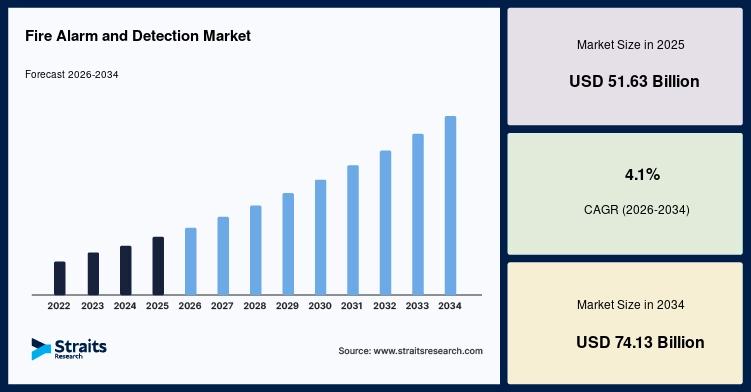
The global fire alarm and detection market was valued at USD 51.63 billion in 2025 and is projected to grow from USD 53.75 billion in 2026 to USD 74.12 billion by 2034, registering a CAGR of 4.1% during the forecast period (2026–2034). North America dominated the market in 2025, accounting for 36.4% of global revenue, while Asia Pacific is expected to be the fastest-growing region, with a projected CAGR of 9.15%.
Market Size (2025): USD 51.63 billion
Market Size (2026): USD 53.75 billion
CAGR (Forecast Period): 4.1% from 2026 to 2034
Forecast Year: 2034
Projected Market Size (2034): USD 74.12 billion
Dominant Region: North America—36.4% market share in 2025
Fastest Growing Region: Asia Pacific – CAGR of 9.15% during 2026–2034
Market Overview
Fire alarm and detection systems identify early signs of fire through smoke, heat, or flame sensors and alert occupants and emergency personnel through audible, visual, and connected notification systems. The market includes fire detectors, alarm panels, notification devices, and monitoring solutions used in residential, commercial, industrial, and institutional buildings. Addressable systems, wireless detectors, and networked monitoring platforms help facilities manage alarms across multiple zones and buildings, while integration with building management systems supports coordinated emergency response.Growth Drivers
Construction of data centers and other mission-critical facilities is increasing the need for specialized fire detection systems. High-density server racks, electrical infrastructure, and battery installations require early warning technologies that can identify smoke before a fire becomes visible or spreads. Aspirating smoke detection systems, which continuously sample air through pipe networks, are particularly relevant in these environments because they can detect very low smoke concentrations. This requirement creates opportunities for advanced detectors and connected fire-safety platforms designed for facilities where service interruptions can be costly.Market Challenges
False alarms caused by dust, steam, aerosols, and other environmental interference can interrupt operations and increase inspection and maintenance costs. These issues are particularly challenging in industrial facilities, hotels, airports, and other high-occupancy environments. Installation costs also rise when buildings require extensive cabling, integration with legacy systems, or upgrades to meet applicable fire codes, potentially delaying projects where budgets are constrained.Market Opportunities
Manufacturers can expand revenue through connected fire-safety platforms that combine detectors, alarm panels, remote monitoring, diagnostics, and building management integration. Large commercial campuses, hospitals, data centers, and industrial sites offer opportunities for centralized monitoring systems that simplify supervision across multiple buildings. Suppliers can also develop retrofit solutions for older properties and residential systems that integrate with smart-home platforms, creating additional sales through equipment upgrades, installation services, software, and ongoing maintenance.Segment Analysis
By product, the fire detector segment accounted for the largest market share at 58.7% in 2025. Smoke, heat, and flame detectors form the primary sensing layer of fire protection systems across residential, commercial, and industrial properties. Their broad installation across new buildings and existing facilities supports the segment’s leading position.By application, the residential segment is projected to record the fastest growth, at a CAGR of 8.45% during 2026–2034. Wider adoption of connected home-safety devices, residential construction, and the installation of smoke and heat detectors create opportunities for manufacturers. Wireless connectivity and integration with smart-home platforms also make residential systems easier to monitor and manage.
Regional Analysis
The North America fire alarm and detection market accounted for the largest regional share of 36.4% in 2025. Established fire-safety standards, commercial building requirements, and investment in healthcare facilities, data centers, and industrial infrastructure support the region. The United States remains an important market for addressable alarm panels, connected detectors, and integrated life-safety systems.The Asia Pacific Fire Alarm and Detection Market is expected to grow at a CAGR of 9.15% during the forecast period, showcasing the fastest-growing regional market. Urban development, high-rise construction, industrial expansion, and investment in digital infrastructure are increasing the need for reliable fire detection. China, India, and Japan offer opportunities across commercial buildings, residential properties, transportation infrastructure, and manufacturing facilities. Europe also remains significant due to established building safety requirements and modernization projects, while Latin America and the Middle East and Africa offer opportunities as commercial and industrial infrastructure expands.
Competitive Landscape
The fire alarm and detection market includes global life-safety technology providers and specialist fire detection manufacturers. Competition centers on detection accuracy, system reliability, regulatory certification, interoperability, installation costs, and after-sales support. Established suppliers are developing connected monitoring platforms and scalable control systems, while product innovation increasingly focuses on reducing nuisance alarms, simplifying maintenance, and improving visibility across large facilities.Key companies include:
Honeywell International Inc.
Johnson Controls International plc
Siemens AG
Robert Bosch GmbH
Hochiki Corporation
Recent Developments
In August 2026, Johnson Controls introduced next-generation Simplex Incident Manager and Autocall Fire Site Administrator workstations. The platforms support centralized monitoring and control of up to 250,000 devices and can connect up to 687 fire alarm control units, helping operators manage complex facilities through a unified interface.The development highlights a broader product direction in fire safety: connecting individual detection systems to centralized monitoring environments. Such platforms can help hospitals, campuses, data centers, and large commercial properties coordinate responses and maintain visibility across multiple buildings.
Click to Read the Complete Insights & Report: https://straitsresearch.com/report/fire-alarm-and-detection-market
Future Outlook
The fire alarm and detection market is expected to expand through 2034 as building safety requirements, infrastructure investment, and specialized facility needs support equipment adoption. North America is expected to retain its leading regional position, while Asia Pacific is projected to grow fastest. Manufacturers that combine reliable detection, fewer nuisance alarms, connected monitoring, and straightforward system integration can strengthen their position across new construction and retrofit projects.About Straits Research
Straits Research is a market research and intelligence firm providing industry analysis, market sizing, forecasts, and strategic insights across multiple sectors. Its research supports businesses and decision-makers in understanding market dynamics, competitive positioning, and potential growth opportunities.
Media
Sorry, no items found.