

-
Disaster Recovery Solution Market Opportunities in Cloud Infrastructure and Enterprise IT
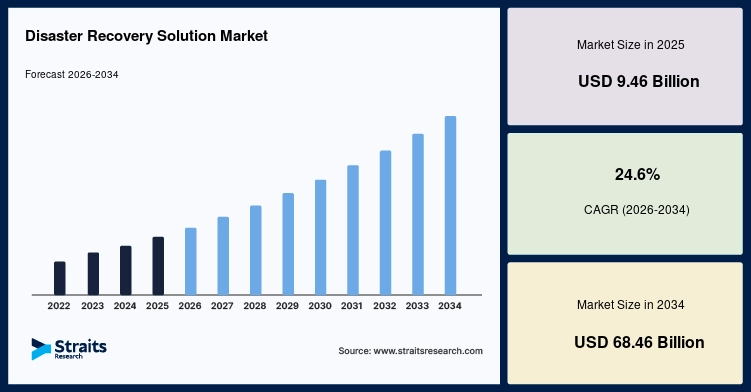
According to Straits Research, the global disaster recovery solution market size was valued at USD 9.46 billion in 2025 and is projected to grow from USD 11.79 billion in 2026 to USD 68.48 billion by 2034, registering a CAGR of 24.6% during the forecast period. North America held the largest regional share at 38.4% in 2025, while Asia Pacific is identified as the fastest-growing region. Greater exposure to cyberattacks, rising dependence on digital business applications, and the need for business continuity are expected to support market growth.
Market Size 2025: USD 9.46 billion
Market Size 2026: USD 11.79 billion
CAGR (Forecast Period): 24.6%
Forecast Year: 2034
Projected Market Size: USD 68.48 billion
Dominant Region: North America – 38.4% share in 2025
Fastest Growing Region: Asia Pacific
Market Overview
Disaster recovery solutions include technologies, processes, and services that restore IT systems, applications, and data after disruptions such as cyberattacks, hardware failures, natural disasters, and power outages. These solutions cover data backup, replication, cloud recovery, system restoration, and failover capabilities. They help organizations reduce downtime, limit data loss, and maintain business continuity. Key users include financial institutions, government agencies, healthcare providers, manufacturers, and telecommunications companies.Growth Drivers
Rising Cyberattack Incidents: Ransomware, malware, and unauthorized system access increase the need for reliable recovery plans across enterprises. Recovery platforms help restore applications, databases, and business systems after security incidents.Dependence on Digital Business Applications: Finance, healthcare, retail, and manufacturing rely on digital platforms for essential operations. System failures can interrupt payments, patient record access, inventory control, and other services, which supports investment in recovery tools.
Data Protection Regulations: Privacy, data retention, and operational compliance rules encourage enterprises to establish formal recovery systems. This supports demand for solutions that protect critical records and help maintain access to business data.
Market Challenges
High Initial Deployment Costs: Software licenses, backup infrastructure, network resources, and implementation services raise the cost of disaster recovery solutions. These expenses can limit adoption among small and medium-sized enterprises.Complex IT Infrastructure Integration: Legacy systems, databases, and enterprise applications may create compatibility issues during deployment. Integration work can increase implementation time and technical costs.
Shortage of Skilled Professionals: Disaster recovery requires expertise in data protection, cybersecurity, and IT infrastructure. Limited access to qualified specialists can lead to implementation delays and weaker recovery readiness.
Market Opportunities
Healthcare IT Recovery Solutions: Hospitals, diagnostic laboratories, and healthcare technology providers need to restore electronic health records, laboratory databases, and clinical applications after system failures. Providers can generate revenue through customized recovery software, implementation contracts, data restoration services, and long-term support agreements.Industrial Control System Recovery: Manufacturing firms, energy companies, and industrial operators require recovery tools for plant control applications, production databases, and operational software. Technology providers can expand through industrial recovery platforms, infrastructure assessments, system configuration, and maintenance contracts.
Segment Analysis
By type, backup and recovery held a market share of 39.6% in 2025. Its essential role in data protection, system restoration, and business continuity supports its leading position across enterprises that need to recover critical information after cyberattacks and system failures.Virtualized disaster recovery is expected to grow at a CAGR of 14.1% during the forecast period. Virtual infrastructure allows businesses to replicate workloads and restore virtual machines across remote environments, which can reduce recovery time and infrastructure costs.
By deployment type, public cloud held a market share of 38.7% in 2025. Its scalability, remote data access, and lower need for physical infrastructure support adoption among organizations of different sizes.
Hybrid cloud solutions are expected to grow at a CAGR of 14.6% during the forecast period. Their ability to combine private infrastructure with public cloud resources gives enterprises more options for workload protection and recovery planning.
By end user, BFSI held a market share of 24.6% in 2025. Financial institutions require reliable access to transaction records, payment systems, and customer data, which supports investment in recovery platforms.
Regional Analysis
North America held the largest market share at 38.4% in 2025, supported by high enterprise cybersecurity investment, mature cloud infrastructure, and strong requirements for business continuity. Financial services, healthcare, and government organizations represent key users of disaster recovery solutions.Asia Pacific is identified as the fastest-growing region. Greater digital adoption, data center investment, cloud infrastructure development, and increased focus on cyber resilience are expected to support regional demand. Europe remains an established market due to data protection requirements and enterprise technology investment. Latin America and the Middle East and Africa offer opportunities as organizations strengthen IT infrastructure and recovery readiness.
Competitive Landscape
The market is moderately concentrated, with data protection software providers, cloud infrastructure companies, and IT recovery service firms competing through recovery speed, scalability, and enterprise data protection capabilities. IBM, Microsoft, Dell EMC, Cisco, and Hewlett Packard Enterprise account for approximately 40%–50% of the global market share. Established players focus on recovery time, data security, and infrastructure integration, while specialized providers develop cloud-native platforms, automated backup tools, and cost-efficient recovery services.Recent Developments
February 2026: Kyndryl launched its Intelligent Recovery Service, a cloud-based solution designed to automate recovery processes and provide visibility across hybrid and multi-cloud environments. The service is integrated with Kyndryl Bridge and supports business continuity and regulatory compliance.June 2026: Cristie launched Cristie Recovery Solution for MSPs, a recovery platform built on Rubrik’s backup and recovery technology. It combines cyber recovery, disaster recovery, automated recovery verification, and a pay-per-use model for managed service providers.
April 2026: Microsoft expanded Azure Site Recovery capabilities with cloud-based disaster recovery features designed to improve workload protection, automation, and recovery management across hybrid and multicloud infrastructure.
Click to Read the Complete Insights & Report: https://straitsresearch.com/report/disaster-recovery-solution-market
Future Outlook
The market is expected to benefit from stronger enterprise focus on cyber resilience, data protection, and operational continuity. Cloud-based recovery, automated failover, immutable backup storage, and managed recovery services may gain wider use as IT environments become more complex. Providers that demonstrate reliable recovery performance and support hybrid and multicloud systems are likely to strengthen their position.About Straits Research
Straits Research is a market intelligence and consulting firm that provides industry insights, market forecasts, and strategic research across a broad range of sectors. The company helps organizations understand market trends, assess competitive environments, and identify opportunities for business growth.
Media
Sorry, no items found.